


Applied Co is a small cap regional Japanese PC retailer and IT provider with surprisingly good execution that’s moving into higher margin local AI deployments (HPC) and IT services.
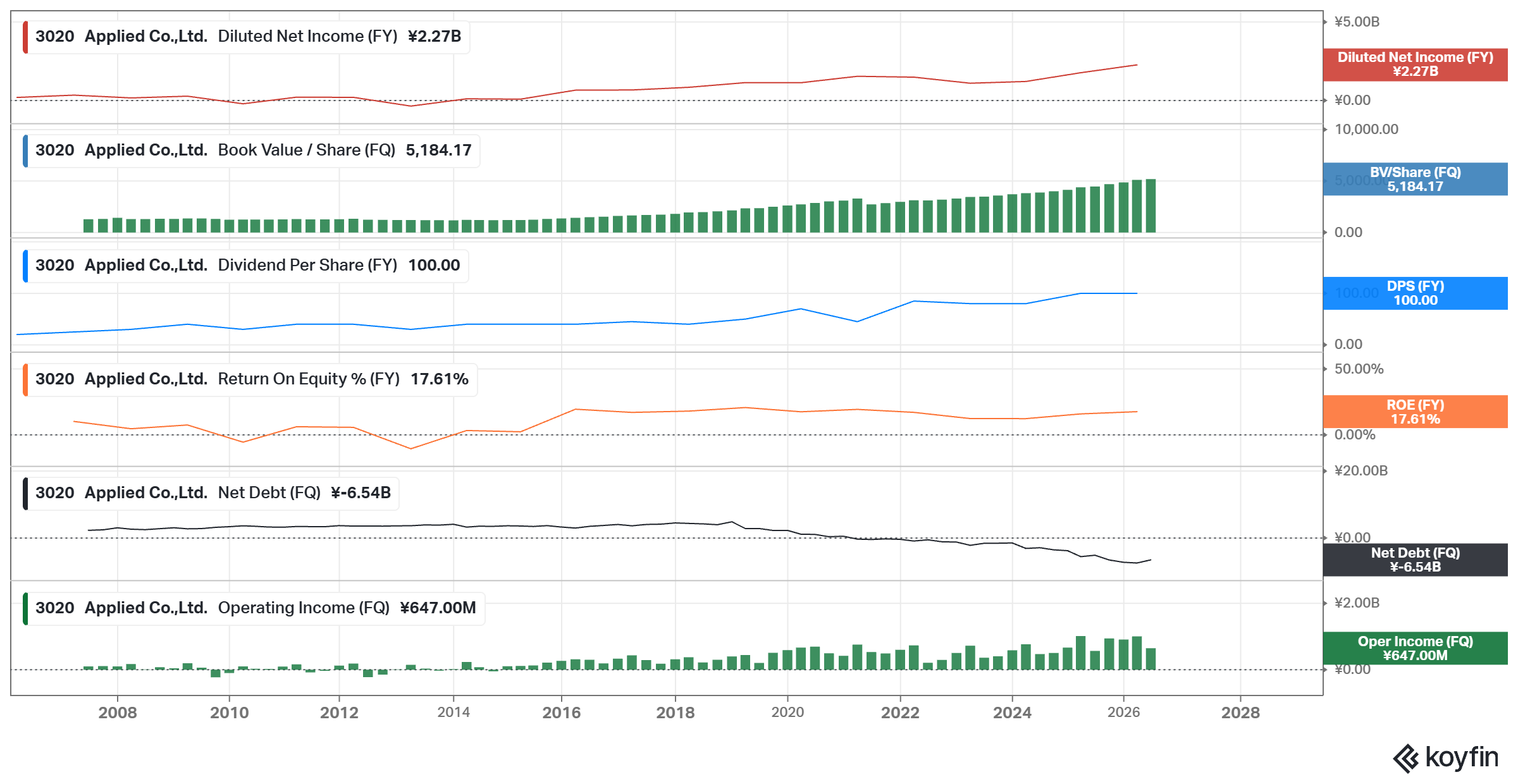
Company-wide return on equity was 17.6% in FY26 despite carrying more than half its market cap in net cash. FY23 and FY24 were historically bad years with 12.3% RoE while FY2016-FY2022 bounced around 17-20%. This is incredible for such an over capitalized business.
Much larger domestic electronic stores like BIC Camera and Yamada Holdings reported 10% and 4% return on equity. Applied is a tiny company, but historical growth and profitability is a strong sign that the company is well run. While gross margins are always lower at Applied vs larger chains, SG&A ratio is much lower, which results in a higher operating margin.
Despite the strong underlying business performance in the last 10 years, and a near record high share price, the stock remains cheap at ¥4,355. We’re paying 5.5x management net income forecasts, which may end up proving conservative as the company beat their own forecasts in the last 3 years.
Bain acquired MCJ, a listed Japanese peer, earlier this year at 7x EBITDA. Using similar metrics, Applied would be worth ~¥12,000 per share.
Share price: ¥4,355
Market Cap: ¥11.8 billion
P/E: 5.5x
Applied Co (TYO 3020) is a ~¥12bn Japanese specialty IT company that’s earning ~¥3.5bn of operating profit while holding over ¥6bn in cash and securities. Backing that out values the core business at 1.5x EV/EBIT. One explanation is that Applied must be some terrible melting ice cube PC retailer about to get crushed as the Windows 10 replacement cycle ends and DRAM/NAND prices explode.
I don’t think that’s what’s happening.
While the Windows 10 replacement cycle boosted profits in FY2025–FY2026, the company’s profits have trended upwards since FY2016, well before that cycle began. Recent profitability has also held up despite that upgrade cycle winding down. Management forecasts FY27 operating profit to decline 5.3%, but so far Q1 has shown a 14% increase year over year.
Applied does operate a chain of regional PC stores, but the more interesting part of the business sells custom PCs, workstations, HPC systems and increasingly AI-related computing infrastructure to universities, government agencies and corporates (think DGX Sparks, MSI WS300, RTX PRO Blackwell 6000 GPU systems, etc.). The company doesn’t break down how much profit comes from the HPC side, but the overall direction of sales and profits has remained strong. They sell complete systems from other brands as well as their own custom systems tailored specifically to customers.
I’ve posted about Applied before on X (here and here) with my main thesis at the time being embedded inventory gains. Shortage of high end GPUs meant system integrators like Applied could sell higher priced gaming PCs with top tier GPUs which carry higher margins than the components themselves. They were also talking about AI systems pretty early on.
Applied is just a well run efficient business
Applied is sitting on a massive pile of net cash equal to about half its market cap and, despite that, it’s still earning 17.6% RoE. SG&A as a % of revenue is also much lower than at larger consumer electronics retailers. The company’s profitability inflection came in FY2016, when the core business became much more focused on B2B and much better at attaching services to hardware sales. A PC has very thin margins, but a PC sold with setup, data migration, security, warranty and technical support services has much stronger margins. Since FY2016, RoE has remained largely flat despite the balance sheet going from ¥3bn in net debt to ¥6.5bn in net cash. That large cash balance is a drag on RoE, and if they dividend out the entire net cash balance and get back to ¥3bn in net debt, RoE would be over 50%. A conservative Japanese company is obviously not going to do this, but the point of the exercise is to demonstrate that profitability has improved since FY2016 even though RoE has fallen a bit.
The B2B HPC side of the business seems the most promising and the company lists 700+ HPC/AI server deployment case studies on their website. In addition to selling the systems, the company offers installation, on-site setup/configuration, maintenance, etc. The company’s corporate recruitment site lists their goal to be the #1 in HPC sales in Japan. Applied is also 1 of 53 NVIDIA partners in Japan, which is impressive for a $75m company. In addition to selling / servicing their own systems, Applied also provides IT support for AI/HPC systems sold by other vendors as well.
While Applied’s core business is excellent, the company also operates a non-core, money-losing lifestyle business led by the founder’s daughter called How’s, which reported ¥10.263bn in revenue and an operating loss of ¥36m. It operates five physical stores and mostly sells cosmetics and general household merchandise. There’s also a non-core publishing and advertising business, but it at least earned ¥39m in operating profit. If we strip these businesses out, Applied’s core PC/SI margins look even better. It’s worth emphasizing that How’s wasn’t created for the founder’s daughter. It existed before she joined the company in 2011. Applied acquired How’s when it bought Comroad in 2007, which operated both a PC retail business and the cosmetics business that became How’s. The positive here is that the company isn’t really investing much in these terrible side businesses.
This thing is cheap. Really cheap.
While far from a net-net, Applied is still really cheap at 5.5x P/E. Market cap is ¥11.7bn today, but after backing out NCAV and other financial/non-operating assets, we’re paying ~¥3bn for the operating business, which is incredibly cheap for a business forecast to earn ¥2.15bn in net income and ¥3.25bn in operating income. Those forecasts also look conservative based on the last few years:
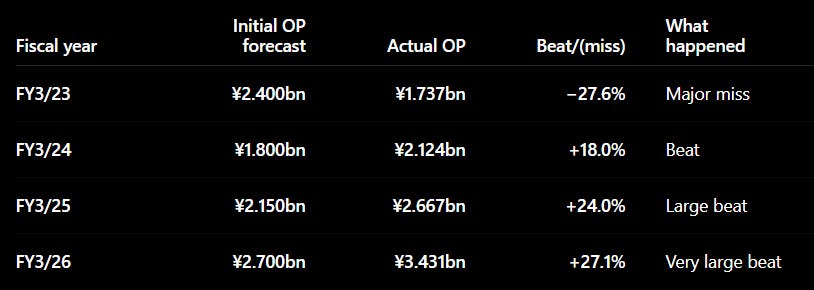
The FY23 miss gives us some interesting context into management’s thinking as well. The initial forecast was released in May 2022 and was cut from ¥2.4bn to ¥1.1bn in November. Management cited the post covid remote work falloff as the primary reason behind the fall in profits. This new forecast proved conservative as they later raised the forecast to ¥1.5bn in February and eventually reported ¥1.737bn in operating profit. When things go wrong, management is quick to cut guidance deeply and subsequently beat it.
Potential MBO & Takeover Comp
There’s also a potential corporate-action angle. The 73 year old founder and his family control ~52% of the company. Most of that stake sits inside a family holding company run by his daughter, and that holding company has already borrowed from SMBC specifically to buy more Applied shares in the past (A small amount). I don’t think you need an MBO for the stock to work, but Applied is cheap enough that the family could theoretically buy out every minority shareholder at a huge premium and still be acquiring the business at a bargain valuation.
And we recently got a pretty useful comp. MCJ (TYO: 6670), a much larger Japanese build-to-order PC company with its own AI/HPC exposure, was taken private by Bain at roughly 7x forward EBITDA earlier this year. Applied currently trades at around 1.4x EV/EBITDA. At that same multiple, Applied would be worth ~¥12,000 per share. Some MCJ shareholders even argued that 7x was too low a price! MCJ was also very similar to Applied in terms of margins. MCJ has more than 5x Applied’s revenue, so its superior gross margin isn’t surprising, while Applied wins on SG&A as a percentage of revenue. If Applied can grow in scale, its gross margins should improve too.
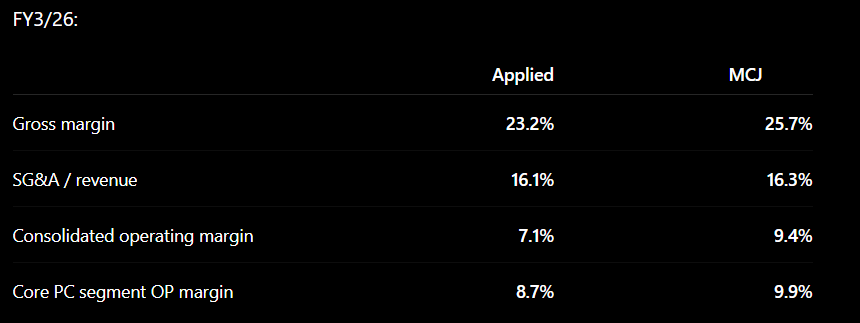
Applied is obviously not MCJ. It’s smaller, less diversified and has a mostly useless lifestyle-retail business attached to it. But I’m not sure those differences justify the operating business being valued at a fraction of the multiple.
The pitch here is pretty simple: I’m paying a near liquidation multiple for a very profitable business whose mix may actually be getting better, with AI/HPC optionality and a free MBO lottery ticket attached.
Why this opportunity exists:
This opportunity, like many of the small/nanocaps I write about, is simply too small for most funds to even look at. U.S. retail investors are chasing Nvidia and Tesla, while Japanese retail investors are largely doing the same. The only people looking at tiny, illiquid companies like this are a handful of foreign and local investors who don’t manage huge sums of capital.
I once replied saying I liked Applied to someone on X who was pitching a much larger consumer electronics store on X who simply replied: “Market cap of JPY 7bn. Please”. Their larger company pitch worked out great, which was up 51%, only a bit less than Applied, which is up 62% since. I can’t even fault someone for rolling their eyes at this tiny company. It’s just too small for bigger investors and even those willing to own a small position likely won’t bother as its extremely illiquid (Average daily volume is ~$46,720. Some days it trades just a couple hundred shares).
David Orr, a fund manager I follow, also liked the name back in 2025 but mentioned the volume is just too damn low and he wanted an excuse to own it because “my god is this a cheap stock”. It’s up 55% since his post!
I’ve owned 3020 since early 2023 and recently increased my position size. While it’s always hard to buy when you’re already up 100% on a stock, this company is still way too cheap and given the M&A comp with MCJ and optionality with HPC, I’m comfortable owning an above average basket position here.
Edit: Sept 11, 2026:
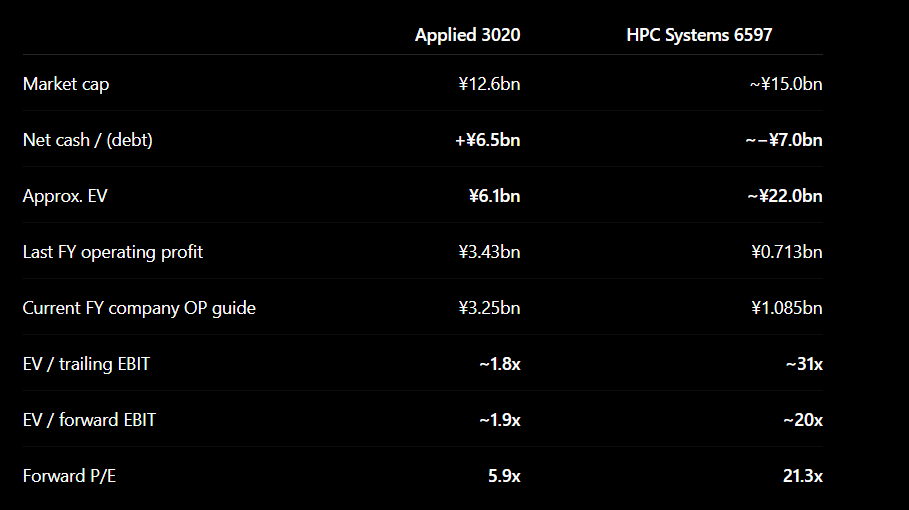
HPC Systems (TYO 6597) is a good comp for what the Japanese market is willing to pay for a small cap pure play HPC company, and it’s a lot. The market won’t assign any kind of HPC multiple to Applied because management does not break down HPC revenues and instead just bundles it all together in a single “PC/Game” category. If the company ever reports HPC revenue seperately we may get a re-rating. I don’t mean to suggest HPC Systems is too expensive. Without knowing how much of Applied’s ¥48bn forecasted FY27 revenue is from HPC, the comparison to HPC Systems (¥10.4bn FY27 forecast revenue) isn’t too useful.
Few negatives:
Large family ownership means activism becomes nearly impossible. The dividend isn’t great at 2.3% and shares outstanding have been largely flat for decades with some dilution (~6%) in 2020, which was interestingly used to partially fund additional HPC/AI capabilities. This was years before ChatGPT made the AI theme more obvious.
Conclusion:
This thing is just too cheap and management seems competent. This is an above average basket sized bet for me.
Disclosure: I own shares in Applied Co (3020). The security could be sold at any point in time without prior notice. This is a small position as part of a broader basket of cheap Japanese companies so I haven’t dug too deep into this name. If I missed anything important, feel free to share in the comments. None of this is investment advice. Everything in this post is my own opinion and I could be wrong. Do your own due diligence.
How much of Applied's cash needs to stay in the business as HPC orders grow? I'm trying to separate genuinely surplus cash from the inventory and customer funding needed to deliver those systems before backing it all out of EV.
The cash balance makes the modest valuation especially interesting if AI infrastructure demand keeps widening the runway.